Living Memory
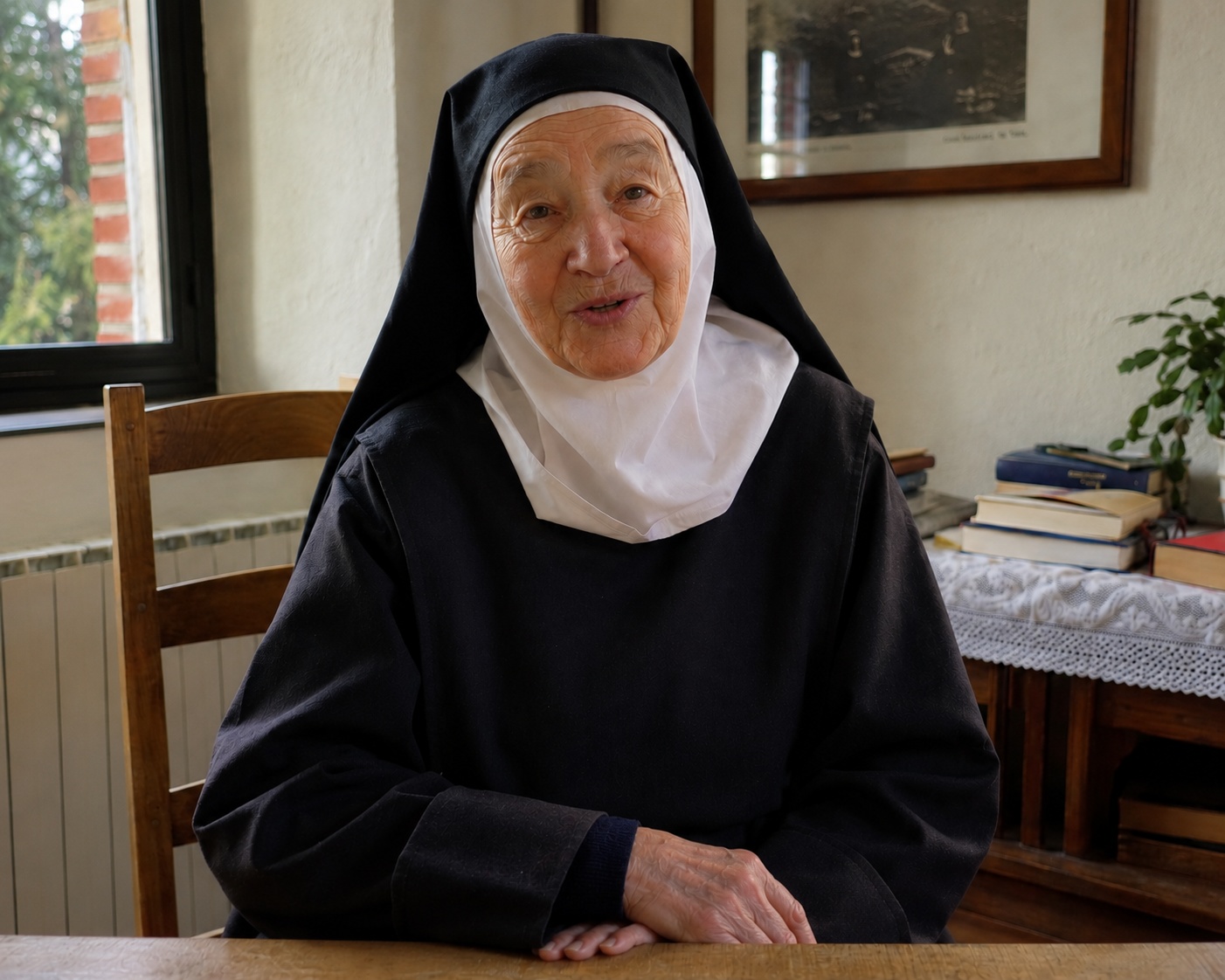
Sœur Marie-Bernard
Lille Region, France · Beginner/Intermediate French
Sœur Marie-Bernard was born Lucie Carlier near Lille around 1941 and has spent more than sixty years as a Cistercian Bernardine nun. Through simple French, learners encounter wartime family memory, postwar rural life, Northern French culture, monastery life, Vatican II, gardens, food, aging, and the changes she has witnessed across eighty-five years.
Conversations open in the Archive Voices player. Transcripts and captions are available throughout.
- Language
- French
- Location
- Lille Region, France
- Occupation
- Cistercian Bernardine Nun
- Era
- Contemporary · Living Memory
The recording
Hear Sœur Marie-Bernard’s Story
0:00 elapsed of 0:00 total
A short autobiographical introduction in slow, natural French for beginner/intermediate learners.
French Transcript
Bonjour, je m'appelle Sœur Marie Bernard, mais je suis née Lucie Carlier près de Lille vers 1941. Je suis née pendant la guerre. J'étais très petite, alors je ne me souviens pas de tout. Mon père est mort pendant la guerre et mon frère aussi. Je ne les ai presque pas connus. Ma mère m'a beaucoup parlé de cette époque.
Ma famille travaillait dans la terre depuis plusieurs générations. Nous cultivions surtout des endives. Mais chez nous, dans le Nord, on dit souvent des chicons. Oui, des chicons. Je connais très bien les chicons.
Après la guerre, j'ai grandi à la campagne avec ma mère et ma famille. Je suis allée à l'école catholique. J'aidais aussi à la ferme.
Quand j'étais jeune, j'ai compris que je voulais devenir religieuse. Vers 19 ans, je suis entrée au monastère Notre-Dame de la Plaine. Plus tard, je suis devenue Sœur Marie Bernard.
Au début, nous priions beaucoup en latin. Après le Concile Vatican II, nous avons commencé à utiliser plus de français. J'ai vu beaucoup de changements.
Aujourd'hui, j'ai environ 85 ans. Je prie, je lis, je parle avec les autres sœurs et, quand je peux, je vais au jardin. Je vais moins vite qu'avant, bien sûr, mais je suis toujours là.
English Translation
Hello, my name is Sister Marie-Bernard, but I was born Lucie Carlier near Lille around 1941. I was born during the war. I was very young, so I don’t remember everything. My father died during the war, and so did my brother. I hardly knew them. My mother told me a great deal about that time.
My family had worked the land for several generations. We mainly grew endives. But where I come from, in the North, we often call them chicons. Yes, chicons. I know chicons very well.
After the war, I grew up in the countryside with my mother and my family. I went to Catholic school. I also helped on the farm.
When I was young, I realized that I wanted to become a nun. At about nineteen, I entered the Notre-Dame de la Plaine monastery. Later, I became Sister Marie-Bernard.
At first, we prayed a great deal in Latin. After the Second Vatican Council, we began using more French. I have seen many changes.
Today, I am about eighty-five years old. I pray, I read, I talk with the other sisters and, when I can, I go into the garden. I move more slowly than I used to, of course, but I am still here.
Read Lucie at Nineteen — a reconstructed diary entry from 1960, when she was newly entering religious life in Northern France.
Biography
Born Lucie Carlier during the Second World War, Sœur Marie-Bernard grew up in a Franco-Belgian farming family in the Lys River region near Lille. Her family cultivated endives — chicons, as people commonly call them in Northern France — and her childhood was shaped by farm work, Catholic school, her widowed mother, and family memories of wartime loss.
At about nineteen, she entered the Monastère Notre-Dame de La Plaine in Saint-André-lez-Lille and later became Sœur Marie-Bernard. She has lived there for more than sixty years, through changes in religious life, language, technology, French society, and her own community. As a young nun she prayed extensively in Latin; after Vatican II, French became much more prominent in Catholic worship.
Now about eighty-five, she still reads, prays, talks with the other sisters, and spends time in the garden when she can. She moves more slowly than she once did, but remains observant, dryly funny, interested in other people, and very much part of the world around her.
Designed for beginner/intermediate French learners, Sœur Marie-Bernard speaks slowly and naturally. Her story introduces accessible spoken French through the details of an individual life in Northern France.
Sample dialogue
Sœur Marie-Bernard
Nous cultivions surtout des endives.
We grew mostly endives.
You
Des endives ?
Endives?
Sœur Marie-Bernard
Mais chez nous, dans le Nord, on dit souvent des chicons.
But here in the North, we usually say chicons.
Related films
Paris, 1788
Buying Bread Before the French Revolution
A morning queue outside a Paris bakery, and the vocabulary of scarcity, price, and politeness in the months before everything changed.
6 min · Intermediate
Cannes, today
Learning French at a Riviera Marina
Lucien walks the pontoons at seven in the morning, greeting neighbours and naming everything in sight.
8 min · Beginner
Lyon, 1943
A Resistance Courier Delivers a Secret Message
Language under pressure: indirect speech, coded phrasing, and the vocabulary of trust.
11 min · Advanced
From the journal
Language Learning
Why Stories Create Better Language Learners
Vocabulary attached to a person, a place, and a reason is remembered. Vocabulary attached to a list is not.
Character Development
Building Lucien: Generative AI Meets Linguistics, Historical Research, and the Old Storytelling Problem of Creating Someone People Actually Want to Talk To
Most of this information would be unnecessary in a conventional language-learning product, but it’s indispensable to Lucien.
Historical Research
Inside Domingo's Bakery
What the archives told us about flour, price controls, and daily life in a nineteenth-century Mexican city.